
Over the years, working closely with training providers, institute owners, and interior teams across Dhaka, I’ve noticed something important: great institutes don’t treat design as decoration. They see it as a silent teacher.
In this blog, I’ll share real training center design ideas actually used by successful institutes in Dhaka—ideas shaped by tight budgets, limited space, and very real student expectations. No theory-heavy talk. Just practical, human-centered design lessons that work in Bangladesh.
Why Training Center Design Matters More Than Ever in Dhaka
Dhaka is crowded. Roads are busy. Attention spans are shorter than ever.
When students finally arrive at a training center, tired from traffic and heat, the space has one job: make learning feel easier.
Successful institutes understand this. Their Dhaka training center layout isn’t fancy for the sake of it—it’s intentional.
Good design helps:
- Students stay focused longer
- Trainers teach more comfortably
- Institutes look trustworthy and professional
Bad design? It silently pushes students away.
1. Smart Space Planning: Making Small Areas Work Harder
Most training centers in Dhaka don’t have luxury floor space. And that’s okay.
What successful institutes do differently
They stop fighting the space and start using it wisely.
Instead of:
- Oversized reception areas
- Narrow, cluttered classrooms
They opt for:
- Compact but welcoming receptions
- Rectangular classrooms with clear sightlines
- Movable furniture
One IT training center in Mirpur uses foldable desks and stackable chairs. During lectures, it’s a classroom. During workshops, it transforms into group zones. Same room. Two purposes.
This kind of vocational institute design tip saves money and increases usability.

2. Lighting That Wakes the Brain (Not Just the Room)
Lighting is one of the most overlooked training center design ideas—yet one of the most powerful.
Natural light where possible
Institutes in areas like Dhanmondi and Uttara often prioritize:
- Glass partitions
- Open blinds during daytime
Students may not say it out loud, but natural light:
- Reduces eye strain
- Keeps them alert
- Makes the room feel alive
Warm, focused artificial lighting
Where sunlight is limited (hello, inner-city buildings), successful centers use:
- Soft white LED panels
- Desk-focused lighting instead of harsh ceiling bulbs
The result?
Students don’t feel sleepy by 4 PM. And that’s half the battle won.
3. Classroom Layouts That Encourage Participation
Traditional row-after-row seating still exists—but thriving institutes are slowly moving away from it.
Student engagement classroom design in action
Successful training centers experiment with:
- U-shaped seating for discussion-based courses
- Cluster seating for practical or vocational training
- Instructor-friendly movement paths
One corporate training center in Gulshan redesigned their room so trainers could walk through the class, not just stand in front.
Engagement went up. Questions increased. Energy shifted.
Good design doesn’t force interaction.
It invites it.
4. Color Choices That Calm, Focus, and Inspire
White walls are safe. But they’re also… forgettable.
Institutes doing well in Dhaka understand color psychology—even if they don’t call it that.
What works locally
- Soft blues and greens for focus-heavy rooms
- Warm neutrals for long training sessions
- Accent walls with institute branding or motivational quotes
A vocational institute in Mohammadpur painted just one wall with a deep green tone. The rest stayed neutral.
Students describe the room as “comfortable” without knowing why.
That’s good design doing its job quietly.
5. Acoustics: The Hidden Hero of Effective Learning Spaces in Bangladesh
Dhaka is noisy. Horns. Construction. Generators.
Ignoring sound is a mistake many institutes regret later.
Simple acoustic solutions that work
Successful centers use:
- Fabric notice boards
- Curtains instead of bare glass
- Acoustic ceiling panels where budget allows
Even rubber pads under chairs reduce scraping noise.
When students don’t have to strain to hear, they relax.
And relaxed students learn better.
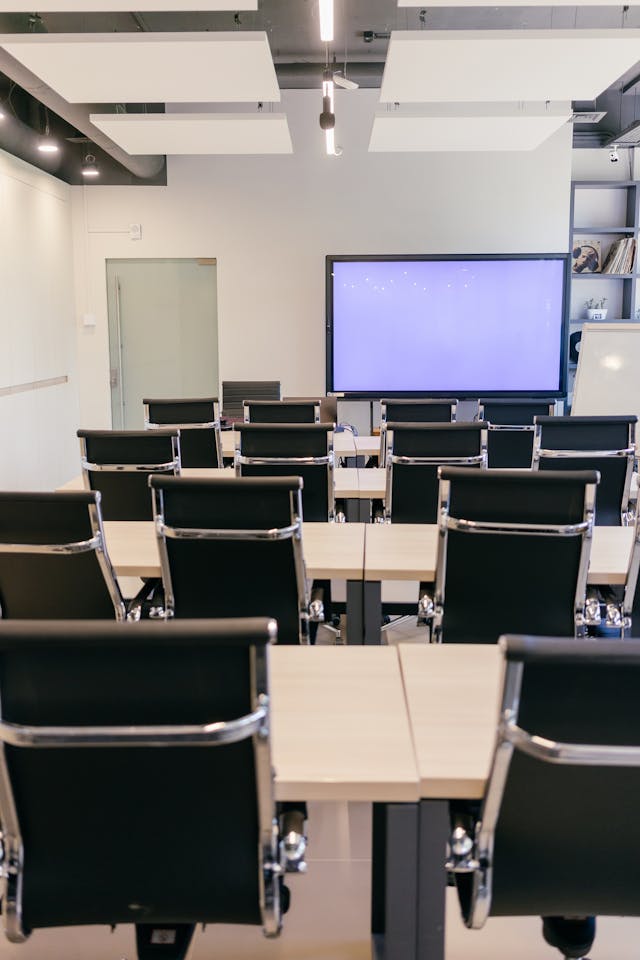
6. Technology That Feels Effortless (Not Overwhelming)
Modern training facility features don’t need to be expensive.
They need to be reliable.
What students actually care about
- Clear projector visibility
- Strong Wi-Fi
- Enough charging points
Institutes that succeed plan:
- Wall-mounted screens at eye level
- Cable management (no dangling wires)
- Backup power solutions
Nothing breaks trust faster than a trainer saying,
“Wi-Fi isn’t working today.”
7. Reception & Waiting Areas That Build Instant Trust
First impressions matter—especially in Dhaka’s competitive training market.
Corporate training center aesthetics that convert
Successful institutes design receptions that are:
- Clean
- Bright
- Uncluttered
Even small touches help:
- Comfortable seating
- Certificates displayed neatly
- A plant or two (real or artificial)
Students may not remember every lesson—but they remember how a place made them feel when they walked in.
8. Trainer Comfort Is Student Success (Often Ignored)
Here’s something many owners overlook:
If trainers are uncomfortable, students feel it.
Successful training centers provide:
- Ergonomic chairs for instructors
- Proper desks, not makeshift tables
- Easy access to boards, screens, and controls
Happy trainers teach better.
Confident trainers attract students.
Simple truth.
9. Flexible Design for Future Growth
Dhaka’s best institutes design with tomorrow in mind.
They ask:
- Can this room handle more students later?
- Can this space host a seminar or exam?
Using:
- Modular partitions
- Neutral base designs
- Scalable layouts
This flexibility saves money long-term and keeps the institute relevant as courses evolve.
Common Design Mistakes Dhaka Institutes Learn the Hard Way
Let’s be honest. I’ve seen these mistakes repeatedly:
- Overcrowded classrooms
- Poor ventilation
- Ignoring student comfort to save cost
The most successful institutes didn’t avoid mistakes—they learned from them and redesigned.
Design is not a one-time decision.
It’s a conversation with your students.
Final Thoughts: Design Is Silent Marketing
The most powerful training center design ideas used by successful institutes in Dhaka share one thing in common: they put people first.